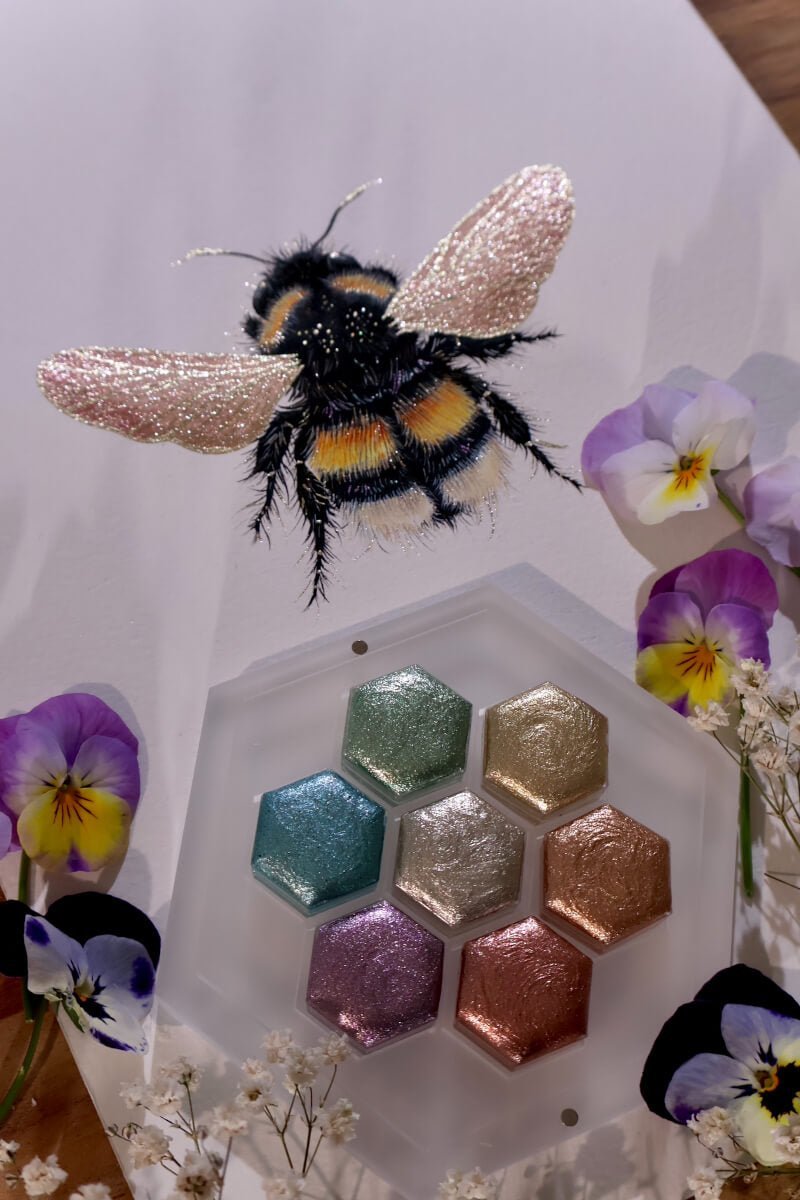
Article: How to Activate Metallic Watercolors | Step-by-Step Guide
How to Activate Metallic Watercolors | Step-by-Step Guide
How much water, how long to wait, and how to get full opacity and intense sparkle in a single brushstroke.
I can't emphasize enough how important it is to activate your metallic watercolors correctly. Pigment types vary, so colors often behave differently — and you need to get a feel for each one at the right consistency. The procedure below works well for our entire range and makes sure you can actually enjoy the sparkle and opacity these colors are made for.
Why Activating Metallic Watercolors Matters
When you brush over a partially dry pan too quickly, you pick up only a fraction of necessary pigments — the result looks watery, thin, and barely sparkles. Taking a minute to activate the paint first is necessary for a fully opaque, light-catching finish. Here is the four-step process I use every day.
Step 1 — Add 1–2 Drops of Water to the Pan
Place one to two drops of water directly onto the surface of your paint. The amount of water is crucial for how the paint behaves: with too much water, the pigment density drops and the color turns translucent. With too little, the brush can't pick up enough paint and it won't apply smoothly. One to two drops is the sweet spot for a single pan.
Step 2 — Wait 3–5 Minutes
Let the water sit for three to five minutes so it can absorb enough pigment. This step is the one most people skip — they start painting right away, and then wonder why the color comes out watery and won't cover. A short wait lets the pigment dissolve properly, and it makes everything that follows easier.
Step 3 — Mix to a Creamy Consistency
Take your brush and mix the water and paint until you reach a smooth, creamy consistency, picking up plenty of pigment as you go. A creamy mix is what gives you a smooth application with full coverage — if your brush feels dry or the paint looks streaky, work in another small drop of water and keep mixing.
Step 4 — Apply for Full Opacity and Sparkle
Now apply the paint to your watercolor paper. With the color properly activated, your brush can take up sufficient amounts of paint and a single stroke should be completely opaque and intensely sparkly under direct light — on both white and black paper.
Adjusting Pigment Density
Once your colors are activated, you can play with the amount of water to control pigment density. Use them fully opaque, keep them semi-opaque, or add just a subtle glitter over areas you've primed with regular watercolors. There's a lot of room to experiment — but I always recommend fully activating your colors first.
Activation Is Only Half of It — the Other Half Is Light
Activating your colors correctly is the first of two things that decide how your metallic watercolors actually look. The second is light. Even a perfectly activated metallic or holo color will look flat and gray without a direct light source — the sparkle, and with our holo pigments the rainbow effect, only appears when light hits the pigment directly. It's important enough to deserve its own post, so I will explained exactly how light, color, and sparkle work together in the next article
Lisi